Lecture 2: Inference Systems and Selection Functions
Laura Kovács and Andrei Voronkov
Inference Systems
- Inference has the form , where and are formulas.
- The formula is called the conclusion of the inference;
- The formulas are called its premises.
- An inference rule is a set of inferences.
- Every inference is called an instance of .
- An Inference system is a set of inference rules.
- Axiom: inference rule with no premises.
Inference System: Example
-
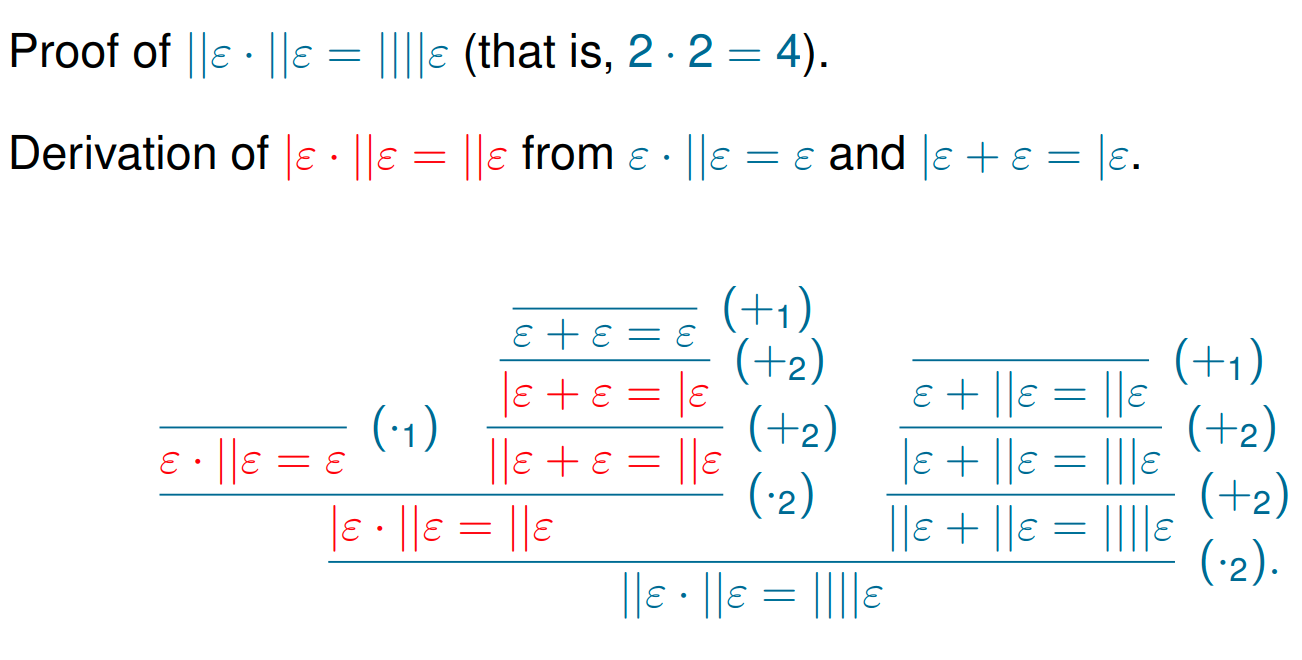
Represent the natural number by the string
-
The following inference system contains 6 inference rules for deriving equalities between expressions containing natural numbers, addition () and multiplication ().
-
-
-
-
-
-
Derivation, Proof
- Derivation in an inference system : a tree built from inferences in .
- If the root of this derivation is , then we say it is a derivation of .
- Proof of : a finite derivation whose leaves are axioms.
- Derivation of from : a finite derivation of whose every leaf is either an axiom or one of the expressions .
Examples
For example,
is an inference that is an instance (special case) of the inference rule:
.
It has one premise, , and the conclusion .
The axiom
is an instance of the rule
Proof, Derivation in this Inference System
Arbitrary First-Order Formulas
- A first-order signature (vocabulary): function symbols (including constants), predicate symbols. Equality is part of the language.
- A set of variables.
- Terms are built using variables and function symbols. For example, .
- Atoms, or atomic formulas are obtained by applying a predicate symbol to a sequence of terms. For example, or .
- Formulas: built from atoms using logical connectives and quantifiers . For example,
Clauses
- Literal: either an atom or its negation .
- Clause: a disjunction of literals, where .
- Empty clause, denoted by : clause with 0 literals, that is, when .
- A formula in Clausal Normal Form (CNF): a conjunction of clauses.
- From now on: A clause is ground if it contains no variables.
- If a clause contains variables, we assume that it implicitly universally quantified. That is, we treat as .
🎬 Animation: Follow a formula through CNF conversion step by step.
Binary Resolution Inference System
The binary resolution inference system, denoted by is an inference system on propositional clauses (or ground clauses).
It consists of two inference rules:
- Binary resolution, denoted by BR:
- Factoring, denoted by Fact:
🎬 Animation: See first-order resolution, including the unifier and resolvent.
Soundness
- An inference is sound if the conclusion of this inference is a logical consequence of its premises.
- An inference system is sound if every inference rule in this system is sound.
- is sound.
- Consequence of soundness:
- let be a set of clauses.
- If can be derived from in , then is unsatisfiable.
Example
Consider the following set of clauses:
Is S unsatisfiable?
The following derivation derives the empty clause from this set:
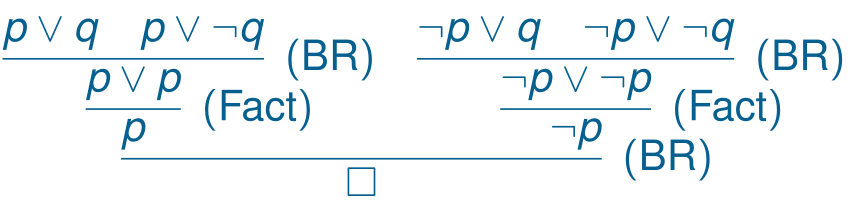
Hence, this set of clauses is unsatisfiable.
Exercise
Consider the following set of clauses:
Show that there exists an infinite number of different derivations of the empty clause from the clauses of .
Can this be used for checking (un)satisfiability?
- What happens when the empty clause cannot be derived from ?
- How can one search for possible derivations of the empty clause?
- Completeness.
- Let be an unsatisfiable set of clauses.
- Then there exists a derivation of from in .
- Let be an unsatisfiable set of clauses.
- We have to formalize search for derivations.
However, before doing this we will introduce a slightly more refined inference system.
Selection Functions
A literal selection function is a function that selects literals in a clause.
- If is non-empty, then at least one literal is selected in .
We denote selected literals by underlining them, e.g.,
- Note: selection function does not have to be a function.
- It can be any oracle that selects literals.
Binary Resolution with Selection
We introduce a family of inference systems, parameterised by a literal selection function .
The binary resolution inference system, denoted by , consists of two inference rules:
- Binary resolution, denoted by
- Positive factoring, denoted by :
Completeness?
Binary resolution with selection may be incomplete, even when factoring is unrestricted (also applied to negative literals).
Consider this set of clauses:
It is unsatisfiable:
Note the linear representation of derivations (used by Vampire and many other provers).
However, any inference with selection applied to this set of clauses give either a clause in this set, or a clause containing a clause in this set.
Literal Orderings
Take any well-founded ordering on atoms, that is, an ordering such that there is no infinite decreasing chain of atoms:
In the sequel will always denote a well-founded ordering.
Extend it to an ordering on literals by:
- If , then and ;
- .
Example: Given . What is the extended ordering on literals?
Exercise: prove that the induced ordering on literals is well-founded too.Orderings and Well-Behaved Selections
Fix an ordering . A literal selection function is well-behaved if either
- a negative literal is selected,
- all maximal literals (w.r.t ) must be selected in C.
To be well-behaved, we sometimes must select more than one different literal in a clause. Example: or .
Completeness of Binary Resolution with Selection
Binary resolution with selection is complete for every well-behaved selection function.
Consider our previous example:
A well-behave selection function must satisfy:
- , because of
- , because of
- , because of
There is no ordering that satisfies these conditions.
Example
Let be boolean atoms and let be the following set of ground formulas:
Take any ordering such that p ≻ q and any selection function over such that
(a) Is a well-behaved selection function over ? (b) How many inferences of are applicable to ?